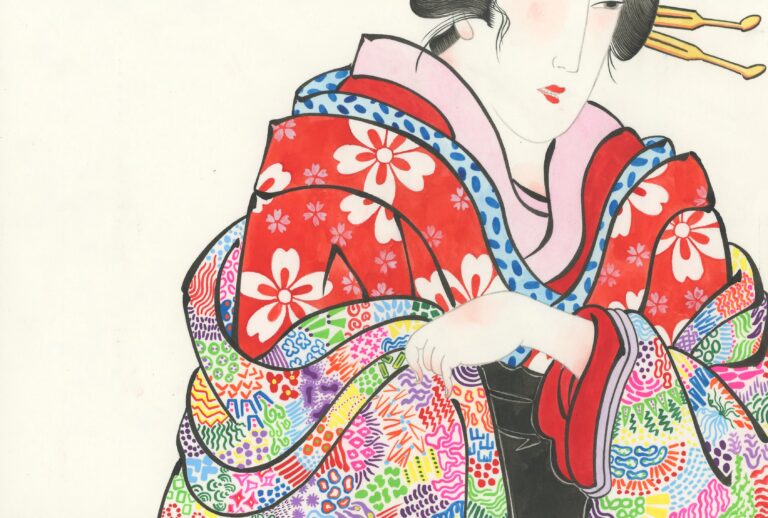
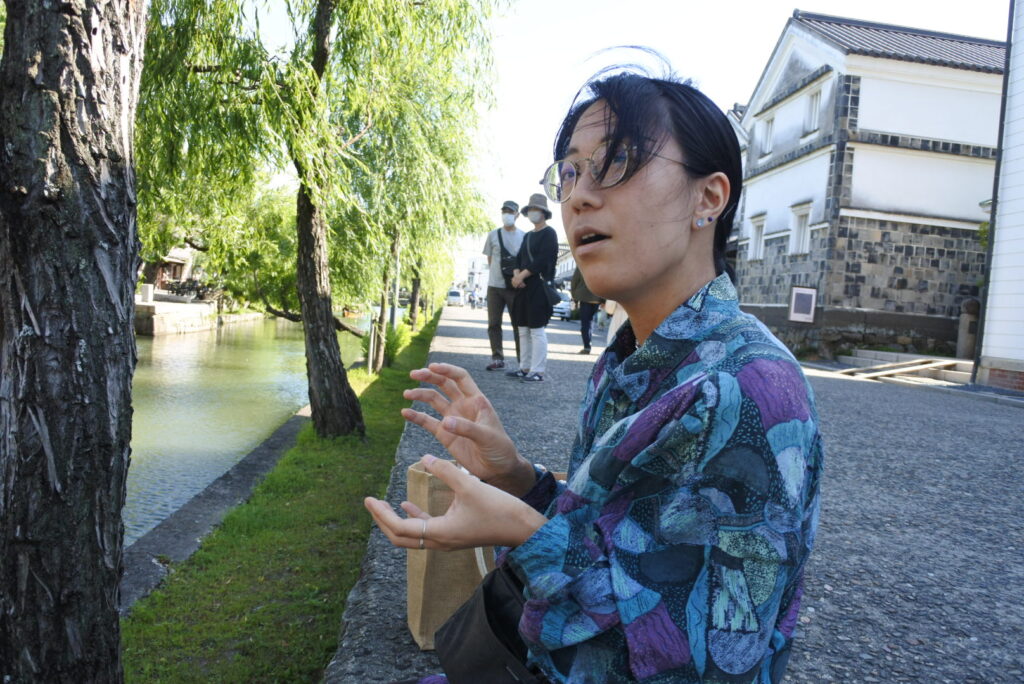
We interviewed Reiko Ikame (井亀 令子), a Okayama-based artist.
She expresses scenes of an “elsewhere” she dreamed of since childhood using the technique of sinking-in gold (沈金技法) in Wajima lacquerware. Wajima lacquerware is a traditional lacquerware produced in Wajima City, Ishikawa Prefecture, Japan. The technique involves layering lacquer on wood, allowing it to dry to create lacquerware with a distinctive gloss and durability.
―You have a background as a traditional craftsman in Wajima lacquerware, correct? What was the initial motivation for entering the world of Wajima lacquerware?
Actually, getting into Wajima lacquerware was kind of impulsive at that time. During my time in art school, a friend who had gone on a trip to Wajima told me during job hunting season that “Wajima lacquerware decoration seems to suit you,” and I became interested in it (laughs). Since I had been drawing a lot during my time in art school, I thought it would be great if I could continue to create my own artwork. I had a liking for traditional crafts and antiques, and I also admired artisans. So, I visited the Wajima Lacquer Techniques Training Institute in Wajima City, observed, took the entrance exam, and ended up enrolling.
The school had the purpose of training successors to human national treasures, so many people around me were entering with aspirations to learn from human national treasure instructors. However, I was clueless at that time (laughs). Even when I looked at the teacher’s works, I didn’t understand the deeper aspects.
As a student, I moved to Wajima and began receiving subcontracted work from lacquerware shops. There was a period when I worked as a salesperson for Wajima lacquerware, but I returned to being an artisan because of a large project that came in. I spent about 10 years in Wajima this way, but I wanted to create my own work, so I became independent and moved to Okayama where my grandfather’s house was located.
―Could you share your reasons for becoming independent? Despite having the option to continue receiving work from lacquerware shops within the world of traditional crafts, why did you choose to become independent?
Lacquerware shops oversee everything from the design of the artwork to the transactions with the sales outlets, essentially managing both production direction and sales. Furthermore, Wajima lacquerware involves specialized artisans for each process, so artisans need to focus on producing the designated designs. In such a scenario, creating works with my own free expression becomes challenging.
Also, I often like to depict themes with shadows, such as ghosts and skulls. However, in the world of traditional crafts, the designs are mostly auspicious symbols, so this kind of dark theme is not in demand in regular Wajima lacquerware (laughs). Since gold is used and the material costs are not cheap, it’s understandable that investing in something that doesn’t fit the typical demand for traditional crafts is difficult for businesses.
―While possessing the skill of a traditional craftsman, you also have your own unique preferences for overall design and details like frames. This might explain your decision to become independent instead of solely working with lacquerware shops.
Indeed, there were many aspects that didn’t align with frames and design from the lacquerware shop’s perspective. I also had a desire to work on those aspects myself.
―Your works seem to have a blend of Japanese aesthetics as well as a Western painting-like quality. What other influences contribute to your art?
I also like Western religious paintings and Greek sculptures, so I think my depictions of human figures are influenced by that. The technique of depicting mountains in the background comes from what I learned in my studies of Japanese painting.
―It’s evident that you’re committed to expressing what you love through your art. Is this dedication central to your work?
Certainly, my desire to depict what I love is strong. I often think about how a particular part of an image could be expressed in a certain way, without being bound to unified conventions.
However, in the case of sinking-in gold, the wood underneath turns black, so techniques with clear shading and drawing, like a traditional “déssin,” are well-suited. This technique allows for intricate details, and in that sense, sinking-in gold might be a good fit for me.
―Speaking of your “déssin,” your artwork is characterized by beautifully flowing lines. Do you have a specific emphasis on lines?
I really like lines that flow smoothly. Even in the lines of hair, for example, I aim for a sense of flowing movement. With sinking-in gold, because the lacquer surface is relatively soft, lines can be drawn smoothly, almost like with a pen. The weight of the chisel used in sinking-in gold allows for drawing, and it’s even smoother than using a pen or pencil. Sinking-in gold chisels come in various shapes, just like pencils can have different degrees of hardness. Especially in the world of Wajima lacquerware’s sinking-in gold, there are unique shapes that make drawing easier.
―In your works, you aim to capture scenes of an “elsewhere.” What emotions do you encapsulate in these depictions, characterized by fantasy, depth, gloss, and a touch of nostalgia?
I consider myself someone who’s like the wind, never staying in one place for long. So, I never really found a fixed sense of belonging here, and at the same time, I always had the feeling of “I want to return, but this is not the place” lingering in the back of my mind. Eventually, this “elsewhere” became an imaginative world within me, and I came to the conclusion that this world is where I belong. So, while facing my artwork, I feel a sense of relief.
―It seems that creating your artwork is a form of immersion into this “elsewhere” for you.
Indeed. Actually, I’ve loved the world of role-playing games like Final Fantasy since I was a child. I wanted to live in the world of games, so for me, art is a form of escapism from the frustrations and pains of the real world, allowing me to immerse myself in a world of fantasy.
―If the real world were to become much happier than it is now, do you think you’d stop creating fantasy art?
I wouldn’t stop creating, but the style might change. As I grow, my perspective changes, so I think my artwork would evolve accordingly. Since becoming independent, I’ve noticed that my work has become less aggressive and the style has become more rounded. Even within ghost paintings, for example, rather than expressing resentment or bitterness, I aim to capture the mystery of such entities.
―Considering your vast array of works, what do you believe is the most essential essence that defines your art?
I would say it’s the interplay of “light and shadow.” One of the most captivating aspects of sinking-in gold is the contrast between light and shadow. The deep black of the lacquer and the shimmer of gold. It’s not about one being better than the other; both complement each other. When using the analogy of light and darkness, darkness is often shunned, but I believe that, just like light, darkness is something necessary for us. Ghosts and monsters are similar. In that sense, I feel that there are things only I can convey.
―What kind of works do you want to create in the future?
I haven’t decided yet. haha.
―Your ability to remain open to various possibilities is one of your remarkable traits. The essence of “light and shadow” is a profound theme, and your art naturally embodies it without appearing overly imposing. This is what lends your work its mysterious charm.
Indeed. I want to follow my feelings rather than impose predetermined ideas.
I believe that I’m suited for creating art without worrying about whether it will sell or if it needs to please others. It takes courage not to worry about selling, but in that sense, I think I have a certain mental strength. If you believe that things will work out somehow, they usually do. It’s like a conviction.
Representative work
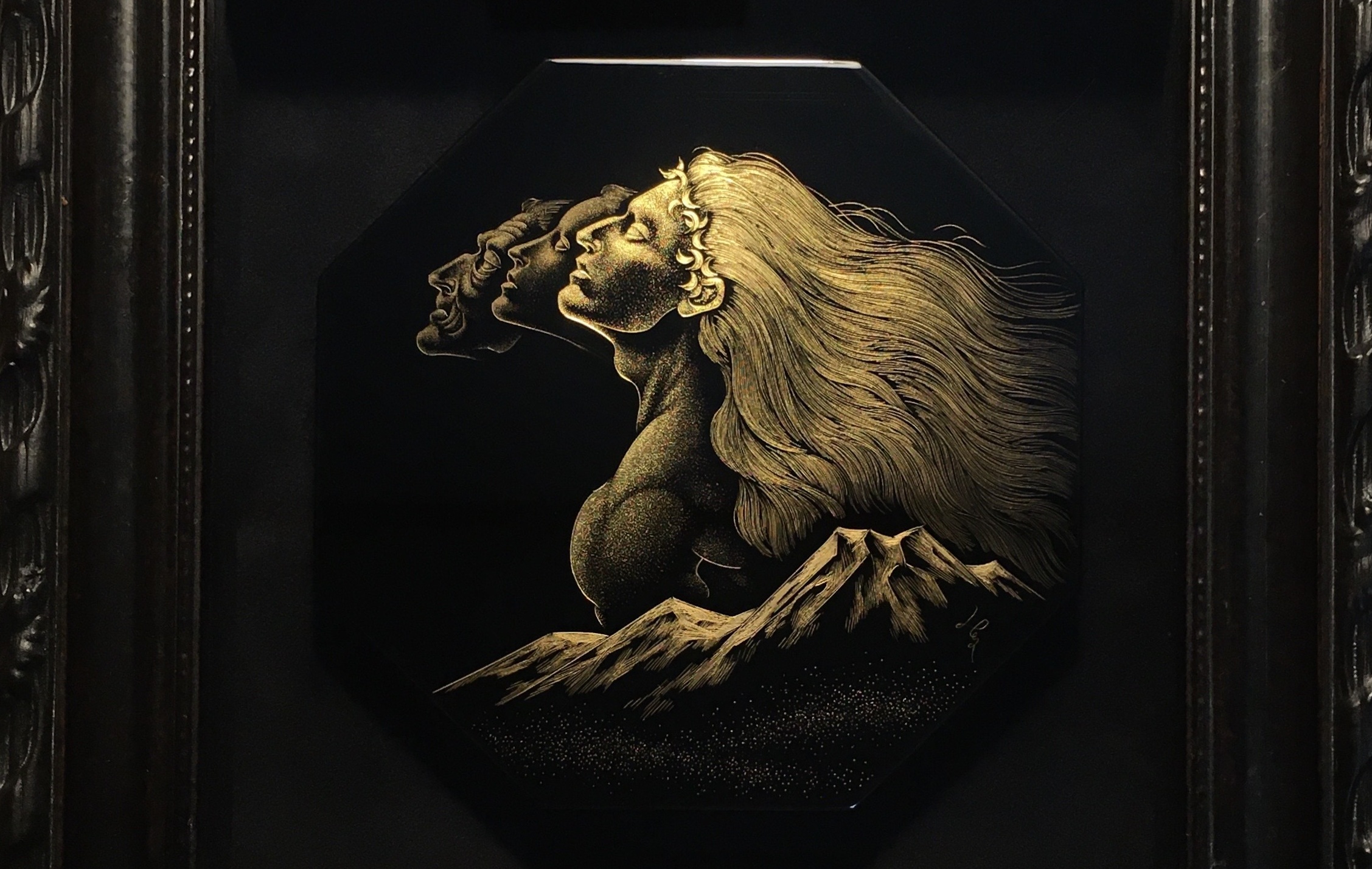
“Amakakeru Kami (天翔ける神)”
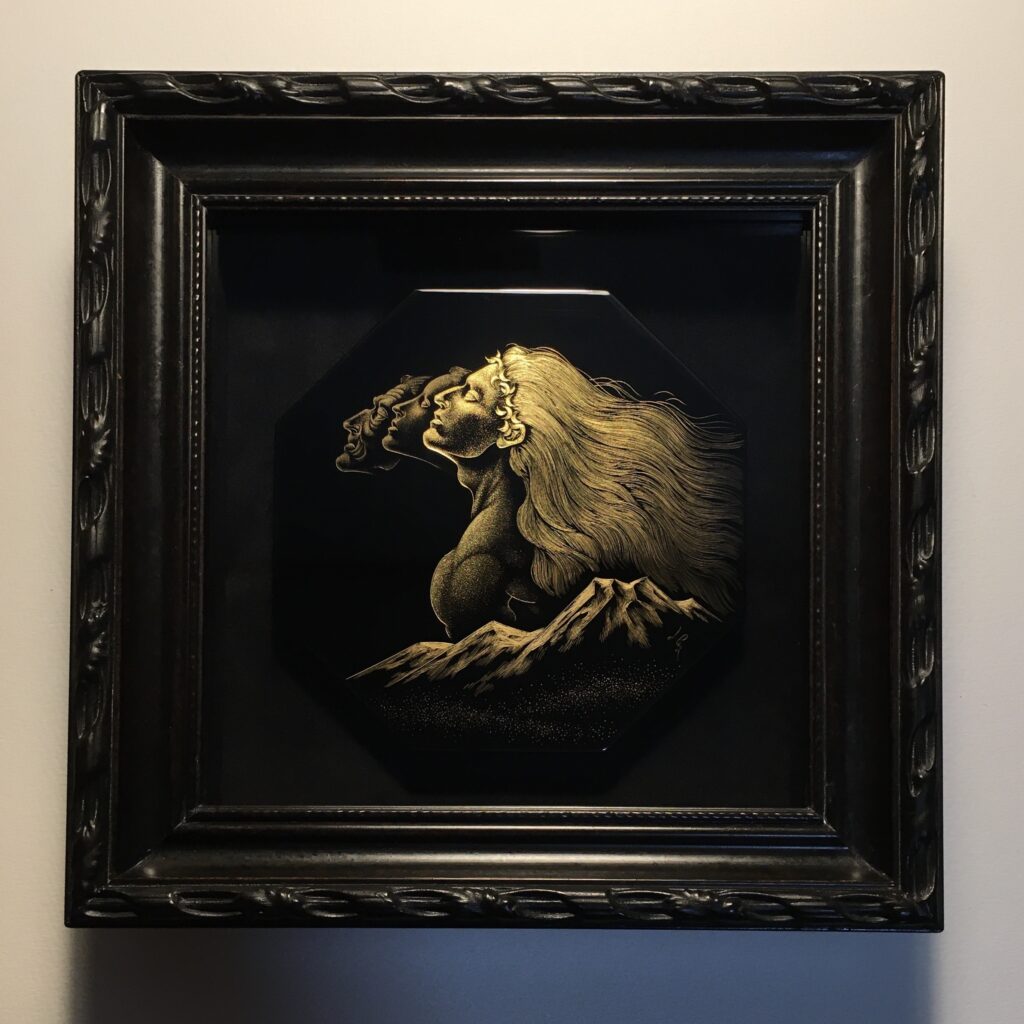
This work is actually based on a dream I had, transformed directly into a sinking-in gold piece.
In the dream, a red earth mountain range appeared against a pitch-black sky, and a golden giant emerged from beyond it, soaring through the air. Although the work doesn’t depict the three faces overlapping, there was an ethereal aura radiating from its frame.
The dream was so impactful that I thought creating a piece based on it would be interesting.
Later, when I shared the dream with a friend, they told me that the giant was actually myself residing on a different star. So, I also see this work as a projection of myself.
Other works
“Taka-Okami-no-Kami (高靇神)“
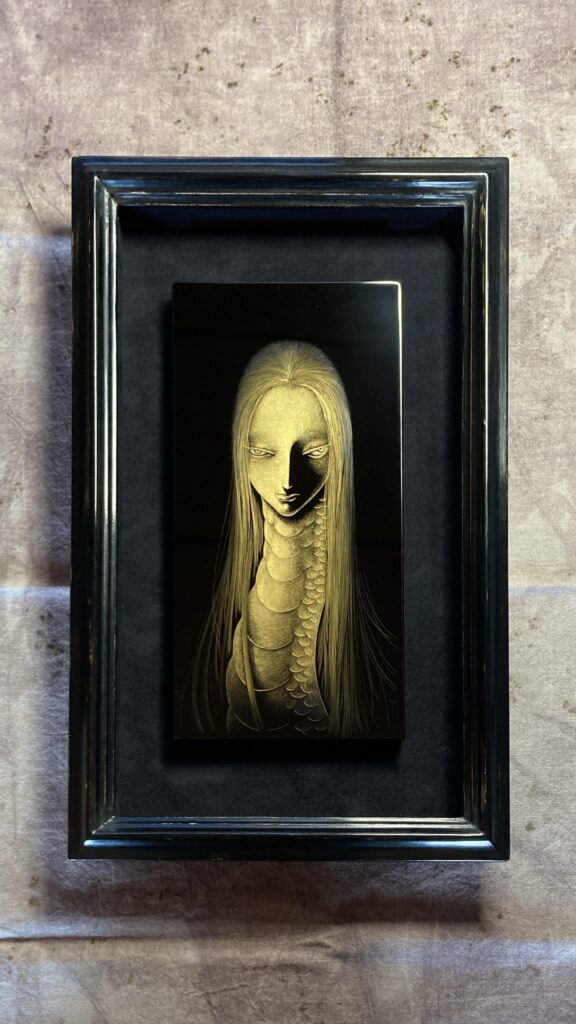
“Untitled”
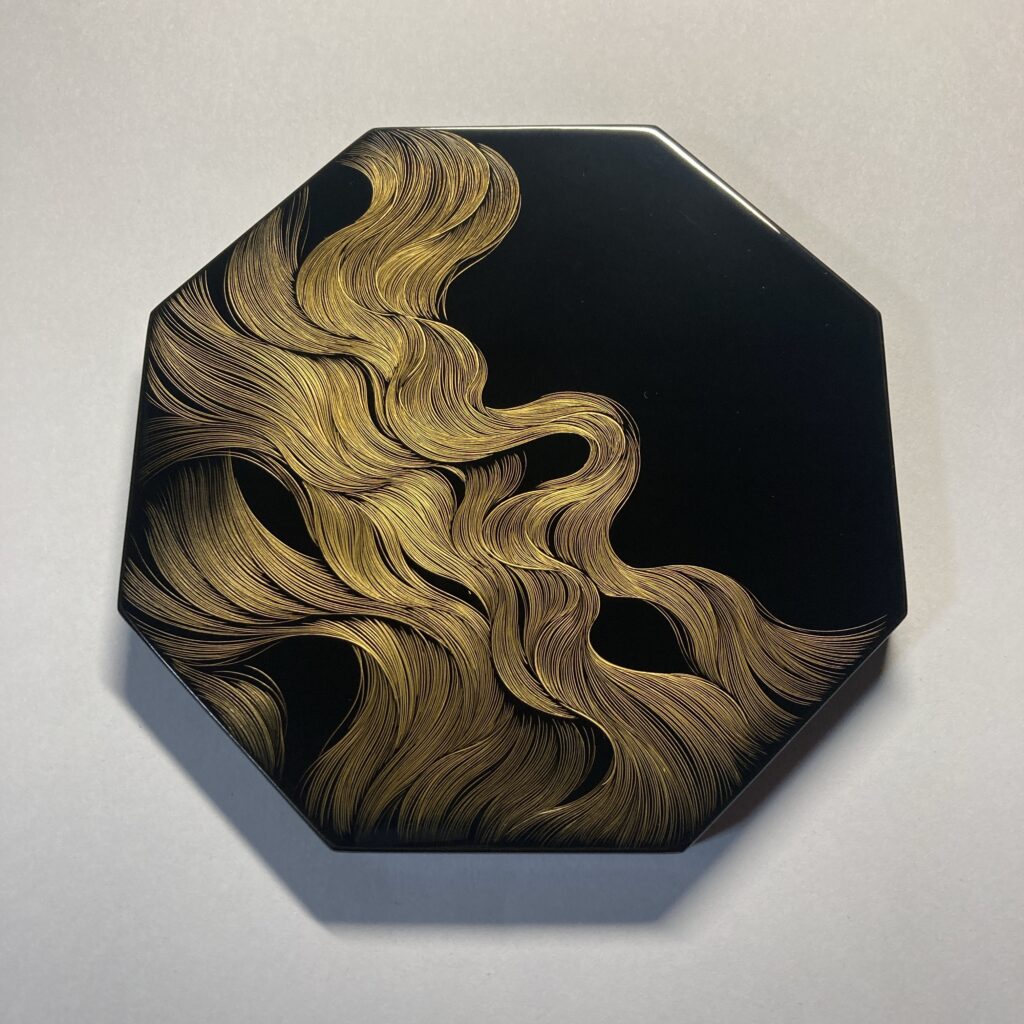
Ikame Reiko (井亀令子)
Sinking-in Gold Artist. Born in Tokyo.
Graduated from Joshibi University of Art and Design with a major in Japanese painting.After university, she enrolled in the Wajima Lacquer Techniques Training Institute.Engaged in Wajima lacquerware for approximately 10 years.
Currently, she works independently, creating artworks using the sinking-in gold technique.
■Exhibition History
- 2014: Selected for the 31st Traditional Japanese Lacquer Art Exhibition.
- 2020: Participated in the Urushi-Tsuboshi Group Exhibition “re: collections Colors and Shapes” (Kanazawa, Craft Hirozaka).
- 2021: Participated in the Ishikawa Prefectural Wajima Lacquer Art Museum’s 30th Anniversary Special Exhibition “Made in Wajima – The Era of Lacquer.”
- 2022: Participated in the “gift Art Exhibition” (Gallery Bjorn Kurashiki Store).
- 2022: Participated in the “gift Art Exhibition” (Gallery Bjorn Kurashiki Store).
- 2022: Participated in the “gift Art Exhibition at Tenmaya Kurashiki Store” (Tenmaya Kurashiki Store).
- 2022: Participated in the “Portrait in Black” Exhibition (Gallery Hydrangea).
- 2023: Participated in the “WoNdERLaND” Exhibition (Tenmaya Kurashiki Store).
- April 2023: Participated in the “Wajima Craft Welcome Path 2023” Exhibition (KALPA).
■Website
HP https://ikamereiko.sakura.ne.jp/
Instagram https://www.instagram.com/pieuquilin/
Online Shop https://pieuquilin.base.shop/