Playful Ukiyo-e – Eriko Yoshida / 吉田 枝里子
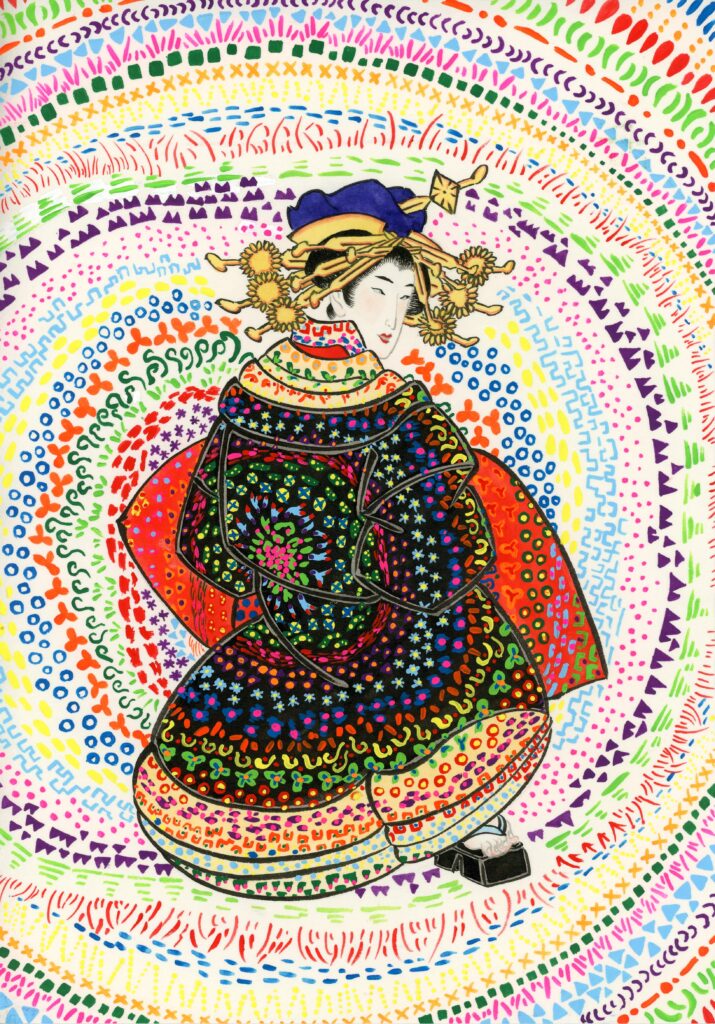
We interviewed Eriko Yoshida (吉田 枝里子), a Tokyo-based artist who paints playful ukiyo-e prints with contemporary elements and abstract paintings in bright pink tones. She is currently creating a new type of art that fuses the two.
―What made you start to paint Ukiyo-e?
Eriko:
My grandfather used to work in the Kabuki industry, so I was always familiar with Ukiyo-e. When I was around high school age, I again thought they were cool. I was also greatly inspired by Hokusai’s wave paintings that I saw around the same time.
―What inspired you to start painting abstract paintings?
Eriko:
After graduating from college, I started working in the Ukiyo-e industry, but since it is a traditional industry, there were rules about colors and painting styles, and I could not use the colors I liked. It was then that I was really struck by the work of an abstract painting artist named Mitsuhito Takeuchi. When I had the opportunity to talk with him, he told me that I should paint with the colors I liked. So I started painting.
―Did your introduction to abstract painting change your view of Ukiyo-e in any way?
Eriko:
I really felt that I could paint freely. In formal settings such as Japanese-style painting, Ukiyo-e, and Kabuki, there are certain rules and common sense that says, “You have to paint like this. On the other hand, abstract painting, which allows me to paint without thinking about it, was a great breakthrough for me. It has allowed me to paint Ukiyo-e more freely than ever before.
―Many of your paintings are impressive in their use of color.
Eriko:
Yes, I do. I pay a lot of attention to color. Japanese colors, including the shades of kimonos, are often quite eccentric, and when you match an obi with a kimono, you often use opposite colors, which I always thought was rock ‘n’ roll.
ukiyo-e itself has an impact, doesn’t it? Therefore, if the colors used are not eccentric, the ukiyo-e will lose out. So color is very important.
―Your paintings are also strikingly bright pink. Why did you decide to use pink as the base color?
Eriko:
For some reason, I have loved pink since I was a student.
Usually, you buy a set of paints for oil or watercolor paintings, but for Japanese-style paintings, you buy the colors you use one at a time. Therefore, each artist uses completely different paints. In my case, I happened to have bought pink for a color scheme, and it was actually very useful. I used it a lot for special occasions. It seems that pink goes well with my paintings.
―What feelings do you put into your paintings when you paint?
Eriko:
It’s like I’m drawing out my frustrations. Last time, when I was having a hard time before my period, I painted a piece called “PMS” (displayed at the bottom of the page) and I finished it in one day. The mental disturbance before menstruation is so bad. It was so bad that my husband was overwhelmed. It was so painful that I thought I had to paint it.
Also, most ukiyo-e artists are men, so I wanted to draw things that only women can draw
such as menstruation and childbirth, or hormone imbalances that make it difficult to sleep at night.
―Do you feel that there is any difference between the pictures that men draw and the pictures that you, as a woman, draw?
Eriko:
It is sometimes said that the women that men draw tend to be their ideal image, but in contrast, I think that the women that women draw are more realistic. I wanted to portray realistic women. Before, I wanted to draw cute and capacious things, but after childbirth, my hormonal balance changed, and those images of women started to break down and crumble within me. I thought that was one of the realities that I could feel because I am a woman. I think I can draw better and more realistic pictures when I am frustrated or have a rough heart, rather than beautiful pictures of motherhood and so on.
―It seems like your style will be changing even more as you raise your children.
Eriko:
Certainly, it may change.
―What kind of pictures would you like to draw in the future?
Eriko:
What I am thinking about now is that I also like clothes, so I would like to try to paint ukiyo-e pictures of clothes I cannot wear. It would be the opposite of the realistic image I mentioned earlier (laughs). I have always admired Valentino heels, but in reality I can’t afford them, so I would draw them in ukiyo-e. I would like to draw a series of Burberry trench coats or something like that.
I would also like to try painting styles that I can’t be brave enough to do in real life, such as pink hair or a style that shows off the stomach.
―As an artist who is going to be drawing pictures and sharing them with the world, what kind of feelings do you want to give to the viewers?
Eriko:
I would like to make people feel a little cheerful when they see my paintings.
―Your paintings say that you are venting out your stress and resentment in your paintings, but at the same time, you don’t force it on the viewer. The balance between the two is very “iki”(a term for “stylish” in Edo period). You don’t take something dark and make it look fun.
Eriko:
The “iki” of the Edo period, the birthplace of ukiyo-e, was to subtly sneak fashion into little places. The back of a happi coat was actually very flashy, or the hem of a kimono was slightly tucked in. I really like that. I don’t really think about it too much, but I think it might be reflected in my style.
―The fact that you are not conscious of it makes it even more “iki”.
Eriko:
There was a time when I was conscious that Ukiyo-e had to be iki because kabuki often has iki lines, but I think it is better to relax and not be conscious of it.
Representative work
“Femininity”
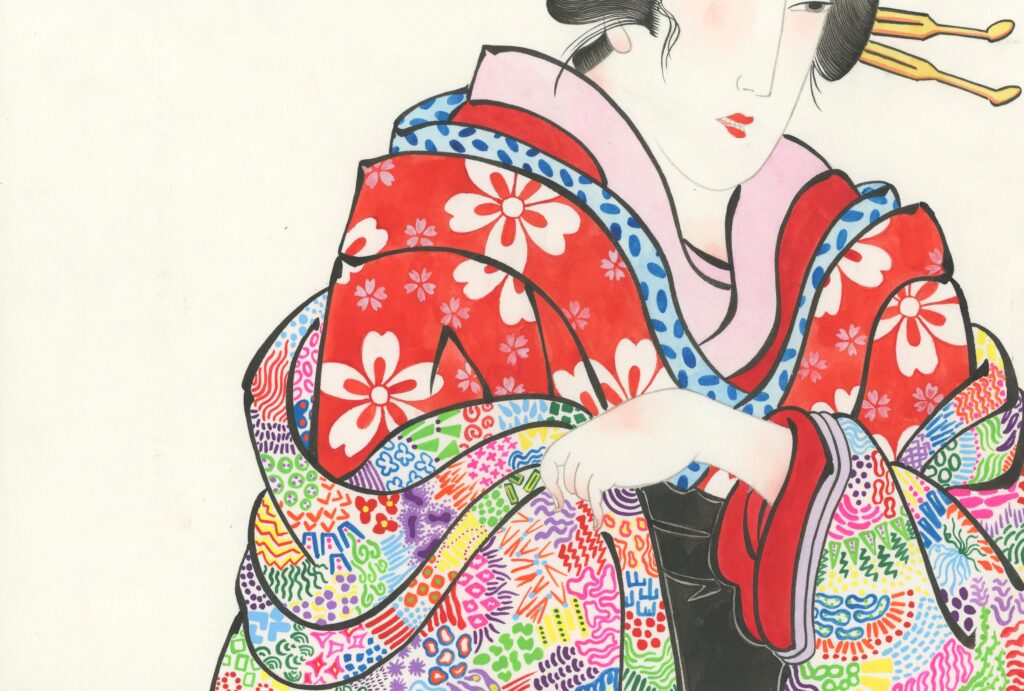
Femininity is the origin of the word “feminine. When you live as a woman, you are often exposed to lookism. Feminine” means “woman’s” or “woman’s” in English, but when the word “feminine” is used in Japan, it adds a strong nuance of being cute or feminine. I really disliked that, and it was always a complex for me when I was in my 20s. I painted this work to show that a woman is a woman no matter how old she gets, no matter how she wakes up from sleep, no matter how disheveled her clothes or hair is, she is still a woman.
At the time when I painted this work, the word “feminism” was quite prevalent, and I felt that it was making women feel constricted. I felt that there was a sense that women should be more free to express themselves in this way. I think I had a feeling that it would be good to be more free.
Other works
“PMS”
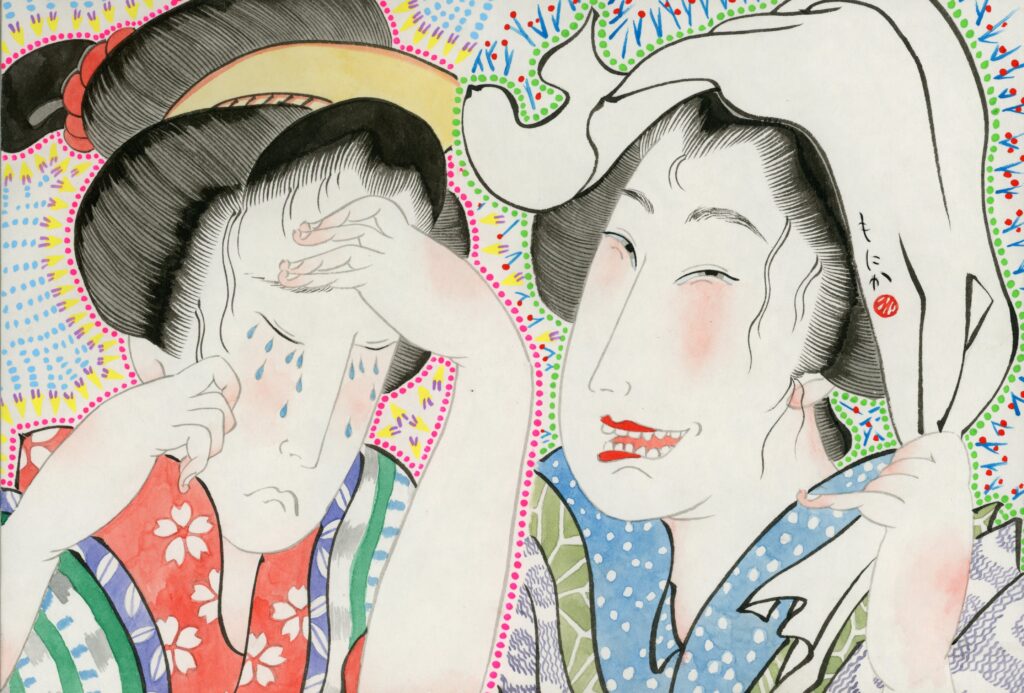
“Hikari” – Shine
Eriko Yoshida (吉田 枝里子)
Ukiyo-e artist, abstract painter. Born in Tokyo.
Graduated from Joshibi University of Art and Design, majoring in Japanese painting.
After graduating from university, I worked for 10 years in Ukiyo-e production.
Currently, she is independent and paints Ukiyo-e and abstract paintings.
Favorite food is Chinese food with authentic taste. Spicy food.
Her hobby is watching sumo wrestling. Her dream is to have a solo exhibition in New York!
■Exhibition History
- December 2018 Wall Painting at Design Festa Gallery, Harajuku, Tokyo
- March 2019 “Sweet Pastel x Vivid Color Exhibition” at AAA GALLERY (Yokohama, Kanagawa)
- November 2019 International Handmade Design Festival 2019″ at Huashan 1914 Cultural and Creative Park, East 2, Pavilion A.B.C.D, Taipei, Taiwan Participation with live painting
- December 2020 “Independent Tokyo 2020 at Tokyo Metropolitan Trade Center Hamamatsucho Pavilion (Hamamatsucho, Tokyo)
- March-April 2021 “F6・Pole 2021 at Amore Ginza Gallery (Ginza, Tokyo)
- April 2021 “THE WORLD OF UKIYO-E at The Ueno Royal Museum (Ueno, Tokyo)
- May-June 2021 “”VISION Ⅰ”-Phantom”” at GALLERY ART POINT (Ginza, Tokyo)
- July 2021 “White T vs. Black T at Atelier Subaru, Izumiotsu, Osaka, Japan
- October 2021 SALON ART SHOPPING PARIS” at Carruousel du Louvre, Paris, France
- May 2022 “ART POINT Selection II 2022″ 6-8 Persons Exhibition” at GALLERY ART POINT, Tokyo
- September 2022 “Flowers” (first solo exhibition) at shelter KUKO café&gallery (Yoyogihachiman, Tokyo)